Why Integrated Systems Thinking Matters
Modern societies possess unprecedented amounts of information, yet many of the problems they face remain poorly understood. Economic instability, institutional fragmentation, environmental degradation, technological disruption, public health crises, and social polarization continue to resist solutions developed within isolated disciplinary frameworks. These are not merely technical failures; they are often failures of systemic understanding.
Over the last several decades, systems thinking has emerged as one of the most important approaches for understanding complexity. Since the 1950s, the framework has been refined and applied across fields such as engineering, management, cybernetics, ecology, sustainability studies, medicine, and organizational analysis. In many of these areas, systems-oriented methods have demonstrated considerable analytical and practical value.
Yet the framework remains unevenly defined and inconsistently applied. Systems thinking is frequently treated either as a specialized technical methodology or as a broad conceptual metaphor, depending on the discipline employing it. As a result, its principles are often fragmented across fields, limiting its ability to function as a coherent interdisciplinary framework.
The Institute for Integrated Systems Thinking was established in response to this challenge. The Institute is dedicated to advancing systems thinking through research, publishing, mentoring, and teaching while developing what it calls the Integrated Knowledge Approach: an approach that seeks to clarify and operationalize systems thinking across disciplines without reducing it to a rigid or closed doctrine.
At the center of the Institute’s work is the view that systems thinking should not be understood as a fixed methodology confined to a single discipline. Rather, it is better understood as a flexible framework of principles capable of expanding or contracting depending on the nature, scale, and complexity of the event under examination. The aim is not to force all disciplines into a single model, but to cultivate analytical approaches capable of recognizing relationships, processes, structures, interactions, and patterns that isolated methods often fail to capture.
If systems thinking is to become more broadly useful, its principles must be clarified without eliminating the flexibility that gives the framework its strength. The challenge, therefore, is not simply the application of systems thinking, but the continuing work of defining, testing, refining, and operationalizing the framework itself.
This is where the Institute locates its primary mission.
The Institute supports interdisciplinary inquiry into systems theory, systems mapping, historical systems analysis, integrated methodologies, and the study of complex human and natural phenomena. Through IST Institute Press, it publishes scholarly, educational, and public-facing works intended to advance systemic literacy and interdisciplinary inquiry. Through seminars, collaborative discussions, and educational initiatives, the Institute also seeks to cultivate broader engagement with systems-oriented analysis among scholars, professionals, students, and the public.
A defining feature of the Institute’s approach is its commitment to historical depth. Contemporary discussions of systems thinking often present the framework as a largely modern development emerging from twentieth-century scientific and managerial traditions. While these traditions remain important, the Institute maintains that many thinkers throughout history articulated principles consistent with systems thinking long before the emergence of modern terminology.
For this reason, the Institute encourages engagement with intellectual traditions across civilizations, historical periods, and disciplinary boundaries. Such engagement is not merely historical or comparative in purpose. It also allows researchers to identify durable conceptual patterns, examine how complex systems were understood in different contexts, and evaluate which principles possess long-term analytical stability.
Systemic problems are rarely confined to a single moment, institution, or discipline. Questions concerning work, governance, ethics, health, ecology, economics, and social organization have long required integrative forms of reasoning capable of connecting multiple layers of human experience and material reality. The Institute therefore approaches systems thinking not simply as a technical tool, but as a broader intellectual framework for understanding interconnectedness across time, scale, and domain.
At the same time, systems thinking must remain practical. The value of any framework ultimately depends on its ability to improve understanding, guide inquiry, and contribute to meaningful forms of analysis and intervention. For this reason, the Institute places particular emphasis on systems mapping, methodological clarity, and the operationalization of systems principles in research and education.
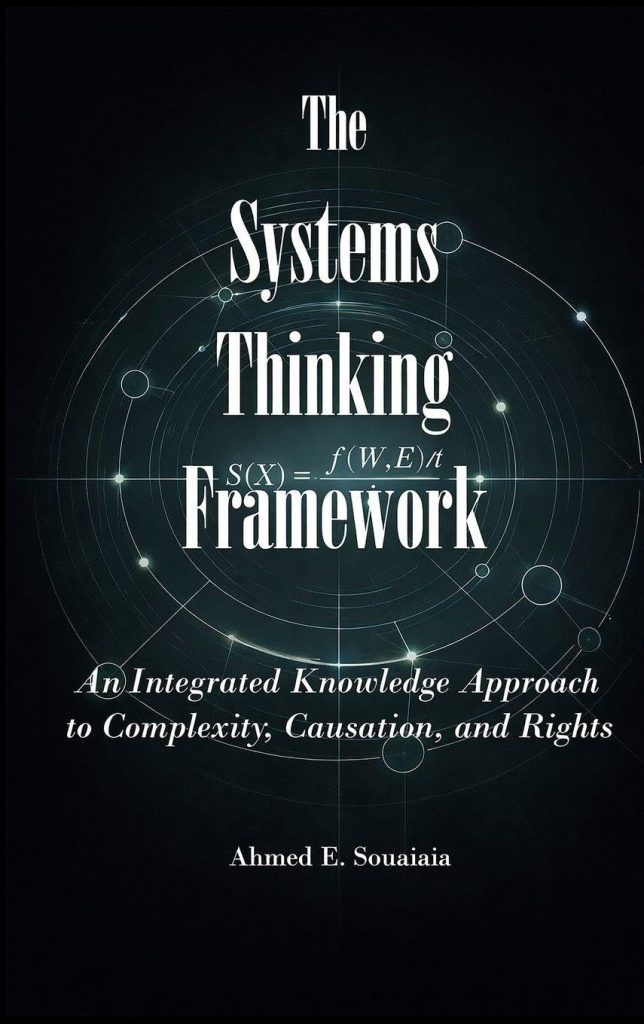
Readers interested in the detailed articulation and operationalization of these principles may refer to The Systems Thinking Framework, where the conceptual foundations, general principles, and applied dimensions of the framework are examined more extensively.
The Institute for Integrated Systems Thinking welcomes collaboration with researchers, educators, professionals, and students from all disciplines who seek to contribute to more integrated, historically grounded, and methodologically rigorous approaches to knowledge and problem-solving.
The challenge facing contemporary scholarship is not merely the accumulation of more information, but the development of more coherent ways of understanding how systems operate, interact, adapt, and transform across time. The work of integrated systems thinking begins from that recognition.